
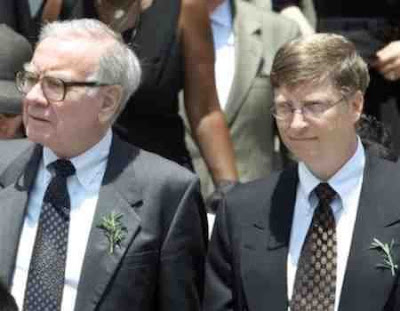
Quotes from the Chairman of Berkshire Hathaway
You are neither right nor wrong because the crowd disagrees with you. You are right because your data and reasoning are right.
We do not view the company itself as the ultimate owner of our business
assets but instead view the company as a conduit through which our shareholders own assets.
When Berkshire buys common stock, we approach the transaction as if we were buying into a private business.
Wide
diversification is only required when investors do not understand what they are doing.
Accounting consequences do not influence our operating or capital-allocation decisions. When acquisition costs are similar, we much prefer to purchase $2 of earnings that is not reportable by us under standard
accounting principles than to purchase $1 of earnings that is reportable.
Never invest in a business you cannot understand.
Unless you can watch your stock holding decline by 50% without becoming panic-stricken, you should not be in the
stock market.
zSB(3,3)
Sponsored Links
Warren Buffett GuideDownload the step-by-step guide to investing just like Warren Buffett.www.BuffettSystem.comInvest in OilLearn The Newest, Most Profitable Ways To Invest in Oil!www.taipanpublishinggroup.comAn End to Retirement WoesThe Only 3 Stocks You Need to Retire Rich. Free Investment Reportwww.DailyWealth.com/Retire_RichWhy not invest your assets in the companies you really like? As Mae West said, "Too much of a good thing can be wonderful".
(When speaking of managers and executive compensation) The .350 hitter expects, and also deserves, a big payoff for his performance - even if he plays for a cellar-dwelling team. And a .150 hitter should get no reward - even if he plays for a pennant winner.
The critical investment factor is determining the intrinsic value of a business and paying a fair or
bargain price.
Risk can be greatly reduced by concentrating on only a few holdings.
Stop trying to predict the direction of the stock market, the
economy,
interest rates, or elections.
Many
stock options in the corporate world have worked in exactly that fashion: they have gained in value simply because management
retained earnings, not because it did well with the capital in its hands.
Buy companies with strong histories of profitability and with a dominant
business franchise.
Be fearful when others are greedy and greedy only when others are fearful.
It is optimism that is the enemy of the rational buyer.
As far as you are concerned, the stock market does not exist. Ignore it.
The ability to say "no" is a tremendous advantage for an investor.
Much success can be attributed to inactivity. Most investors cannot resist the temptation to constantly buy and sell.
Lethargy, bordering on sloth should remain the cornerstone of an investment style.
An investor should act as though he had a lifetime decision card with just twenty punches on it.
Wild swings in share prices have more to do with the "lemming- like" behaviour of institutional investors than with the aggregate
returns of the company they own.
As a group, lemmings have a rotten image, but no individual lemming has ever received bad press.
An investor needs to do very few things right as long as he or she avoids
big mistakes.
"Turn-arounds" seldom turn.
Is management rational?
Is management candid with the shareholders?
Does management resist the institutional imperative?
Do not take yearly results too seriously. Instead, focus on four or five-year averages.
Focus on
return on equity, not
earnings per share.
Calculate "owner earnings" to get a true reflection of value.
Look for companies with high
profit margins.
Growth and
value investing are joined at the hip.
The advice "you never go broke taking a profit" is foolish.
It is more important to say "no" to an opportunity, than to say "yes".
Always invest for the long term.
Does the business have favourable long term prospects?
It is not necessary to do extraordinary things to get extraordinary results.
Remember that the stock market is manic-depressive.
Buy a business, don't rent stocks.
Does the business have a consistent operating history?
An investor should ordinarily hold a small piece of an outstanding business with the same tenacity that an owner would exhibit if he owned all of that business.
The Story of Berkshire Hathaway's Billionaire Chairman
Warren Edward Buffett was born on August 30, 1930 to his father Howard, a stockbroker-turned-Congressman. The only boy, he was the second of three children, and displayed an amazing aptitude for both money and business at a very early age. Acquaintances recount his uncanny ability to calculate columns of numbers off the top of his head - a feat Warren still amazes business colleagues with today.
At only six years old, Buffett purchased 6-packs of Coca Cola from his grandfather's grocery store for twenty five cents and resold each of the bottles for a nickel, pocketing a five cent profit. While other children his age were playing hopscotch and jacks, Warren was making money. Five years later, Buffett took his step into the world of high finance.
zSB(3,3)
Sponsored Links
Warren Buffett GuideDownload the step-by-step guide to investing just like Warren Buffett.www.BuffettSystem.com
Become rich in a monthJoining Serious Paid Receive $5000 daily to your bankseriouspaid.com/?C48212
Free Forex EducationLearn to be a successful trader. With Forex, knowledge is power!www.BabyPips.comAt eleven years old, he purchased three shares of Cities Service Preferred at $38 per share for both himself and his older sister, Doris. Shortly after buying the stock, it fell to just over $27 per share. A frightened but resilient Warren held his shares until they rebounded to $40. He promptly sold them - a mistake he would soon come to regret. Cities Service shot up to $200. The experience taught him one of the basic lessons of investing: patience is a virtue.
Warren Buffett's EducationIn 1947, a seventeen year old Warren Buffett graduated from High School. It was never his intention to go to college; he had already made $5,000 delivering newspapers (this is equal to $42,610.81 in 2000). His father had other plans, and urged his son to attend the Wharton Business School at the University of Pennsylvania. Buffett stayed two years, complaining that he knew more than his professors. When Howard was defeated in the 1948 Congressional race, Warren returned home to Omaha and transferred to the University of Nebraska-Lincoln. Working full-time, he managed to graduate in only three years.
Warren Buffett approached graduate studies with the same resistance he displayed a few years earlier. He was finally persuaded to apply to Harvard Business School, which, in the worst admission decision in history, rejected him as "too young". Slighted, Warren applied to Columbia where famed investors Ben Graham and David Dodd taught - an experience that would forever change his life.
Ben Graham - Buffett's MentorBen Graham had become well known during the 1920's. At a time when the rest of the world was approaching the investment arena as a giant game of roulette, he searched for stocks that were so inexpensive they were almost completely devoid of risk. One of his best known calls was the Northern Pipe Line, an oil transportation company managed by the Rockefellers. The stock was trading at $65 a share, but after studying the balance sheet, Graham realized that the company had bond holdings worth $95 for every share. The value investor tried to convince management to sell the portfolio, but they refused. Shortly thereafter, he waged a proxy war and secured a spot on the Board of Directors. The company sold its bonds and paid a dividend in the amount of $70 per share.
When he was 40 years old, Ben Graham published Security Analysis, one of the greatest works ever penned on the stock market. At the time, it was risky; investing in equities had become a joke (the Dow Jones had fallen from 381.17 to 41.22 over the course of three to four short years following the crash of 1929). It was around this time that Graham came up with the principle of "intrinsic" business value - a measure of a business's true worth that was completely and totally independent of the stock price. Using intrinsic value, investors could decide what a company was worth and make investment decisions accordingly. His subsequent book, The Intelligent Investor, which Warren celebrates as "the greatest book on investing ever written", introduced the world to Mr. Market - the best investment analogy in history.
Through his simple yet profound investment principles, Ben Graham became an idyllic figure to the twenty-one year old Warren Buffett. Reading an old edition of Who's Who, Warren discovered his mentor was the Chairman of a small, unknown insurance company named GEICO. He hopped a train to Washington D.C. one Saturday morning to find the headquarters. When he got there, the doors were locked. Not to be stopped, Buffett relentlessly pounded on the door until a janitor came to open it for him. He asked if there was anyone in the building. As luck (or fate) would have it, there was. It turns out that there was a man still working on the sixth floor. Warren was escorted up to meet him and immediately began asking him questions about the company and its business practices; a conversation that stretched on for four hours. The man was none other than Lorimer Davidson, the Financial Vice President. The experience would be something that stayed with Buffett for the rest of his life. He eventually acquired the entire GEICO company through his corporation, Berkshire Hathaway.
The Influence of Benjamin Graham
Ben Graham - Buffett's Mentor (Continued) Flying through his graduate studies at Columbia, Warren Buffett was the only student ever to earn an A+ in one of Graham's classes. Disappointingly. both Ben Graham and Warren's father advised him not to work on Wall Street after he graduated. Absolutely determined, Buffett offered to work for the Graham partnership for free. Ben turned him down. He preferred to hold his spots for Jews who were not hired at Gentile firms at the time. Warren was crushed.
Warren Buffett Returns HomeReturning home, he took a job at his father's brokerage house and began seeing a girl by the name of Susie Thompson. The relationship eventually turned serious and in April of 1952 the two were married. They rented out a three-room apartment for $65 a month; it was run-down and served as home to several mice.
zSB(3,3)
Sponsored Links
Buffett Investment SystemDownload the step-by-step guide to investing just like Warren Buffett.www.BuffettSystem.com
Invest in ForexSee How Warren Buffett Become Such a Great Investor!www.Easy-Forex.com
Get Filthy RichThese 8 Hot Stocks Are Your Ticket To Explosive Bull Market Gains!www.taipanpublishinggroup.comIt was here their daughter, also named Susie, was born. In order to save money, they made a bed for her in a dresser drawer.
During these initial years, Warren's investments were predominately limited to a Texaco station and some real estate, but neither were successful. It was also during this time he began teaching night classes at the University of Omaha (something that wouldn't have been possible several months before. In an effort to conquer his intense fear of public speaking, Warren took a course by Dale Carnegie). Thankfully, things changed. Ben Graham called one day, inviting the young stockbroker to come to work for him. Warren was finally given the opportunity he had long awaited.
Warren Buffett Goes to Work for Ben GrahamThe couple took a house in the suburbs of New York. Buffett spent his days analyzing S&P reports, searching for investment opportunities. It was during this time that the difference between the Graham and Buffett philosophies began to emerge. Warren became interested in how a company worked - what made it superior to competitors. Ben simply wanted numbers whereas Warren was predominately interested in a company's management as a major factor when deciding to invest, Graham looked only at the balance sheet and income statement; he could care less about corporate leadership. Between 1950 and 1956, Warren built his personal capital up to $140,000 from a mere $9,800. With this war chest, he set his sights back on Omaha and began planning his next move.
On May 1, 1956, Warren Buffett rounded up seven limited partners which included his Sister Doris and Aunt Alice, raising $105,000 in the process. He put in $100 himself, officially creating the Buffett Associates, Ltd. Before the end of the year, he was managing around $300,000 in capital. Small, to say the least, but he had much bigger plans for that pool of money. He purchased a house for $31,500, affectionately nicknamed "Buffett's Folly", and managed his partnerships originally from the bedroom, and later, a small office. By this time, his life had begun to take shape; he had three children, a beautiful wife, and a very successful business.
Over the course of the next five years, the Buffett partnerships racked up an impressive 251.0% profit, while the Dow was up only 74.3%. A somewhat-celebrity in his hometown, Warren never gave stock tips despite constant requests from friends and strangers alike. By 1962, the partnership had capital in excess of $7.2 million, of which a cool $1 million was Buffett's personal stake (he didn't charge a fee for the partnership - rather Warren was entitled to 1/4 of the profits above 4%). He also had more than 90 limited partners across the United States. In one decisive move, he melded the partnerships into a single entity called "Buffett Partnerships Ltd.", upped the minimum investment to $100,000, and opened an office in Kiewit Plaza on Farnam street.
In 1962, a man by the name of Charlie Munger moved back to his childhood home of Omaha from California. Though somewhat snobbish, Munger was brilliant in every sense of the word. He had attended Harvard Law School without a Bachelor's Degree. Introduced by mutual friends, Buffett and Charlie were immediately drawn together, providing the roots for a friendship and business collaboration that would last for the next forty years.
Ten years after its founding, the Buffett Partnership assets were up more than 1,156% compared to the Dow's 122.9%. Acting as lord over assets that had ballooned to $44 million dollars, Warren and Susie's personal stake was $6,849,936. Mr. Buffett, as they say, had arrived.
Wisely enough, just as his persona of success was beginning to be firmly established, Warren Buffett closed the partnership to new accounts. The Vietnam war raged full force on the other side of the world and the stock market was being driven up by those who hadn't been around during the depression. All while voicing his concern for rising stock prices, the partnership pulled its biggest coup in 1968, recording a 59.0% gain in value, catapulting to over $104 million in assets.
Taking Control of Berkshire Hathaway
The next year, Warren went much further than closing the fund to new accounts; he liquidated the partnership. In May 1969, he informed his partners that he was "unable to find any bargains in the current market". Buffett spent the remainder of the year liquidating the portfolio, with the exception of two companies - Berkshire and Diversified Retailing. The shares of Berkshire were distributed among the partners with a letter from Warren informing them that he would, in some capacity, be involved in the business, but was under no obligation to them in the future. Warren was clear in his intention to hold onto his own stake in the company (he owned 29% of the Berkshire Hathaway stock) but his intentions weren't revealed.
Warren Buffett Gains Control of Berkshire HathawayBuffett's role at Berkshire Hathaway had actually been somewhat defined years earlier.
zSB(3,3)
Sponsored Links
Get Paid Every MonthUsing Stimulus Checks Worth $600 Or More. See if You Qualify.www.DailyWealth.com/Stimulus_Report
Warren Buffett SystemDownload the step-by-step guide to investing just like Warren Buffett.www.BuffettSystem.com
Market Maker Venture FundSee Your Money Gaining. The Big Profits For Small Investorswww.marketmakerventurefund.comOn May 10, 1965, after accumulating 49% of the common stock, Warren named himself Director. Terrible management had run the company nearly into the ground, and he was certain with a bit of tweaking, it could be run better. Immediately Mr. Buffett made Ken Chace President of the company, giving him complete autonomy over the organization. Although he refused to award stock options on the basis that it was unfair to shareholders, Warren agreed to cosign a loan for $18,000 for his new President to purchase 1,000 shares of the company's stock.
Two years later, in 1967, Warren asked National Indemnity's founder and controlling shareholder Jack Ringwalt to his office. Asked what he thought the company was worth, Ringwalt told Buffett at least $50 per share, a $17 premium above its then-trading price of $33. Warren offered to buy the whole company on the spot - a move that cost him $8.6 million dollars. That same year, Berkshire paid out a dividend of 10 cents on its outstanding stock. It never happened again; Warren said he "must have been in the bathroom when the dividend was declared".
In 1970, Buffett named himself Chairman of the Board of Berkshire Hathaway and for the first time, wrote the letter to the shareholders (Ken Chace had been responsible for the task in the past). That same year, the Chairman's capital allocation began to display his prudence; textile profits were a pitiful $45,000, while insurance and banking each brought in $2.1 and $2.6 million dollars. The paltry cash brought in from the struggling looms in New Bedford, Massachusetts had provided the stream of capital necessary to start building Berkshire.
A year or so later, Warren Buffett was offered the chance to buy a company by the name of See's Candy. The gourmet chocolate maker sold its own brand of candies to its customers at a premium to regular confectionary treats. The balance sheet reflected what Californians already knew - they were more than willing to pay a bit "extra" for the special "See's" taste. The businessman decided Berkshire would be willing to purchase the company for $25 million in cash. See's owners were holding out for $30 million, but soon conceded. It was the biggest investment Berkshire or Buffett had ever made.
Following several investments and an SEC investigation (after causing a merger to fail, Warren and Munger offered to buy the stock of Wesco, the target company, at the inflated price simply because they thought it was "the right thing to do". Not surprisingly, the government didn't believe them), Buffett began to see Berkshire's net worth climb. From 1965 to 1975, the company's book value rose from $20 per share to around $95. It was also during this period that Warren made his final purchases of Berkshire stock (when the partnership dolled out the shares, he owned 29%. Years later, he had invested more than $15.4 million dollars into the company at an average cost of $32.45 per share). This brought his ownership to over 43% of the stock with Susie holding another 3%. His entire fortune was placed into Berkshire. With no personal holdings, the company had become his sole investment vehicle.
In 1976, Buffett once again became involved with GEICO. The company had recently reported amazingly high losses and its stock was pummeled down to $2 per share. Warren wisely realized that the basic business was still in tact; most of the problem were caused by an inept management. Over the next few years, Berkshire built up its position in this ailing insurer and reaped millions in profits. Benjamin Graham, who still held his fortune in the company, died in in September of the same year, shortly before the turnaround. Years later, the insurance giant would become a fully owned subsidiary of Berkshire.
This post is taken from
about.com
 Address: 26, Jalan PUJ 2/6, Taman Puncak Jalil.
 Address: 13, Jalan PUJ 6/3, Taman Puncak Jalil (next to the unit with a/c)


